The reserve fund balance on a status certificate means nothing in isolation; what matters is whether the board has adopted the funding recommendations from the most recent reserve fund study.
By far, the most common question I get from condo buyers:
"Is $X.XX enough in the reserve fund?"
Sometimes the number in question is $500,000. Sometimes it's $2 million.
And the honest answer is that number, on its own, tells you almost nothing.
This week's video covers condo fees, including how the reserve fund fits into your monthly fee. Worth a watch if you have buyers in the condo market.
But for this newsletter, I want to clarify how I’m addressing that common question above when reviewing a status certificate on a condo deal.
There's no objective minimum for a reserve fund balance. There's no rule that a reserve under $500,000 is universally bad.
Every condo is different: in size, age, building components, amenities... etc.
A high-rise building with 400 units needs a fundamentally different reserve fund than an 80 unit mid-rise.
So the total balance isn't the right question.
The right question:
Is the Condo following the funding recommendations of the Reserve Fund Study?
Under Ontario's Condominium Act, every condo is required to conduct a reserve fund study at least once every three years.
This is where an engineer assesses the physical state of the building. The major components, their expected remaining useful life, and the projected cost of eventual repair or replacement.
From that assessment, the study produces a Future Funding Plan: essentially how much the corporation needs to be contributing to the reserve fund each year to be financially prepared.
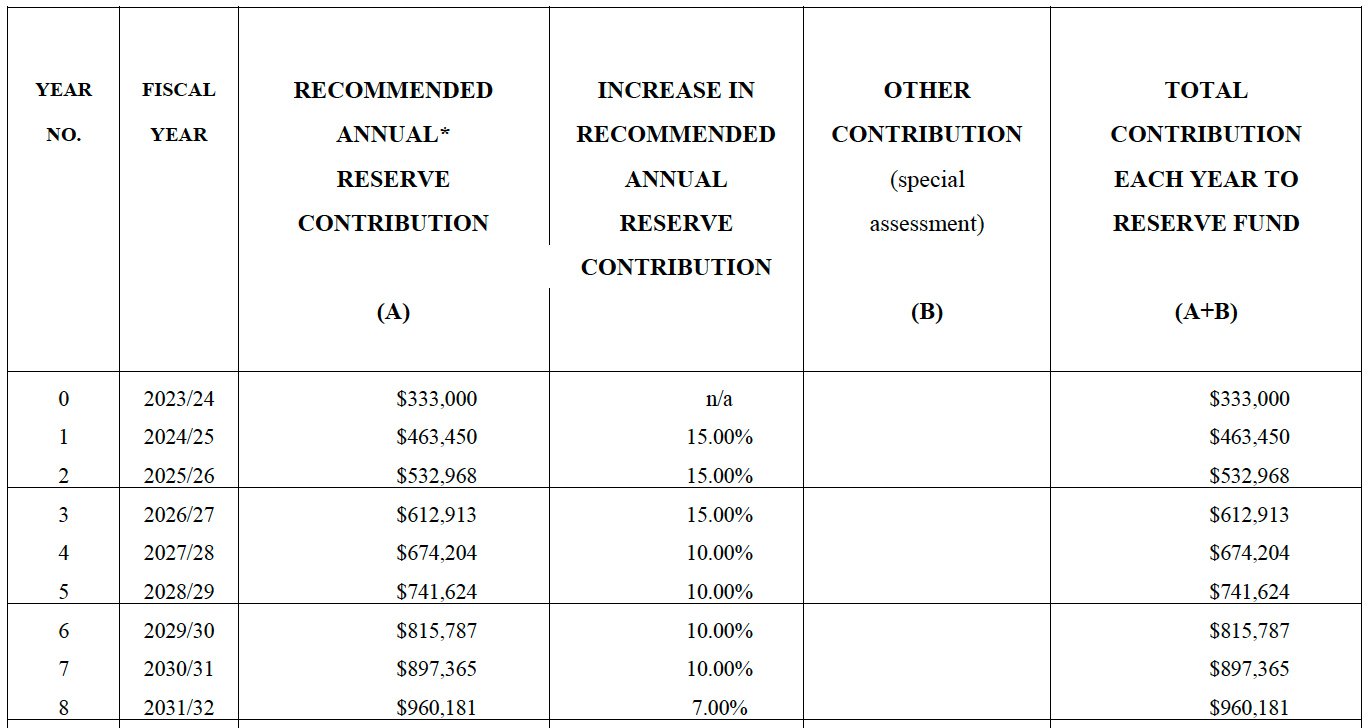
That funding plan is the benchmark.
When I'm reviewing a status certificate, I'm looking to see whether the board has adopted the funding recommendations from the most recent reserve fund study.
A board that hasn't adopted the recommendations could be a red flag. It doesn't necessarily mean don't buy, but it acts as a sign to investigate further.
Why haven't the recommendations been adopted? Is there a shortfall being deferred?
It’s best to get these answers before a client firms up.
Now, in practice, It’s rare to see a board that hasn't adopted the funding recommendations. But when it comes up, it's a red flag and it's exactly the kind of thing the status certificate review is there to catch.
So remember, the balance of the reserve fund alone isn't the full story.
The relationship between that number and the reserve fund study is.
Latest YouTube Video:
Zachary Soccio-Marandola
Real Estate Lawyer
Direct: (647) 797-6881
Email: zachary@socciomarandola.com
Website: socciomarandola.com
1. Real Estate Closings
I represent clients across Ontario on purchases, sales, refinances, and title transfers — with real accessibility, valuable legal insights, and all-inclusive pricing.
🏠 Get an Instant Quote
2. Free Consultations
I offer free consultations for our Realtor subscribers — whether it’s a tough clause, red flag in an offer, or you just want a legal perspective before submitting.
👨💻 Book a Free Consultation
3. Speaking Engagements
I speak at team meetings, brokerage trainings, and events to share legal insights, and help Realtors identify issues before they become costly problems.
🎤 Invite Me to Speak